Tag: order-runnel
Dock District of Karolak
Posted on July 9, 2025

The Dock District is the primary large ship building and large cargo dock for the city of Karolak. To its east is the Scow District.
The Beyne River (“artery of the north”)
Posted on August 15, 2024 in Steel-Realms
The mighty Beyne River is one of the largest rivers in the heartlands, if not THE largest. It is a avenue of commerce, travel, and defense. The North Merchant Cities fall squarely on its banks (Karolak controls the sea exit), flood plains, tributaries, and adjacent lands. Although it is a shared resource, the Merchant Cities are considered its primary Sheppard. Many of the tributary Rivers of the Great Forest of Rhyl end of in the river or Lake Caolite that feeds it directly. The Beyne River is the primary trade route of the North Heartlands of the Steel Realms.
Shipping on the Beyne River
The river current is strong and swift, and boats (usually Beyne River Skidbarges) traveling west move at great speed. More travels east overland against the course of the river, though large boats with bound elementals ply the Beyne River in both directions.
The entry point of the Beyne River from Lake Caolite is referred to as Sillin’s Way.
Passage Through Many Locales
The the south side areas are contested fertile lands that border the East River Run and West River Run counties of the Grand Duchy of Dunstrand.
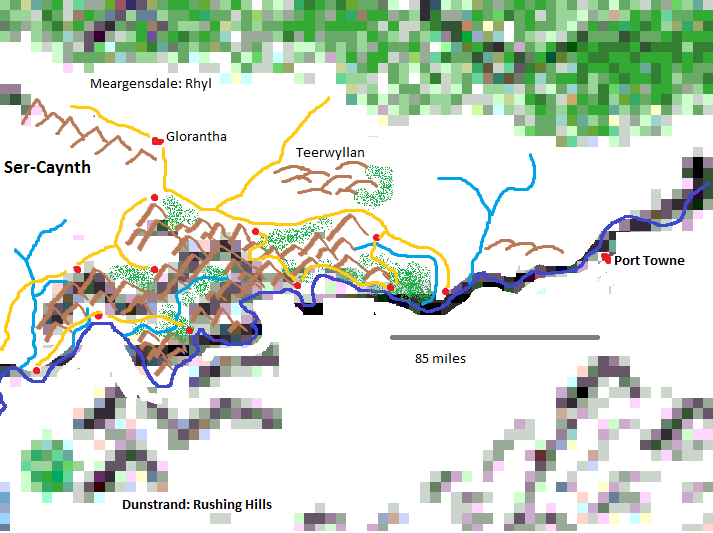
The “Splitting of Ser-Caynth” 5029 The Beyne River changes course south due to the landscape changes stemming from The Sundering/Bale Times instead of through it, clearing the area that would become the Vale of Meargensdale in Rhyl. The territory of Ser-Caynth becomes one of the Fiefs and Territories of the North Merchant Cities.
East of Ser-Caynth is the Southern Edgelands of the Forest of Rhyl north of the river.
A species of Giant Salt Rats developed on the Beyne River – ‘giant water rats’. They are almost as adapt at swimming as otters. They dwell in the sewers under major cities along the shore of river. They are now sacred to the goddess of rats – Irrigi and to the sect of the Runnel Rats.
Beyne River Locales on Lake Caolite
- Bisten’s Hook (Sillin’s Way/Beyne River mouth)
- Sillin’s Western Waylight (Beyne River mouth)
- Driftmans Hollow (Beyne River mouth)
Chronicle of the River
Knowledge is broken down by ease of discovery/availability & Meticulous Record Keeping may improve usability; Any attempt to know more than what's Pervasive will require a reference, source, knowledge, check, or access to someone who can get or provide either of these. Specific Lores may increase the chance of knowing specific elements.
Trivial Outcome / Very Easy Difficulty & Pervasive Knowledge
Information Sources: Mundane Reference | Associated Phenomenology Only | Specific Lore
Simple Outcome / Easy Difficulty & Common Knowledge
It once had more bends to the south, but with the Storm Times, its course became more direct westward.
Ruary (the City of Festivals)
Posted on July 25, 2023 in Steel-Realms
Overview: Ruary is a small city compared to the other Merchant Cities. Its stable population is around 20,000 (about the same mount in many “hamlet” communities). Rare hardy grapes on the north side of the river in a valley which catches the sun light and is fed by streams from a lone short peak. Ruard mountain is sacred to Ikribu and Darupet. Pure and cold and used for brewing is the Artesian spring on the mountain named “Pristos”. On the southern side is hops, barley, corn and oats. The major industry is brewing and distilling of mead, wine, and beer – especially beer. When folks speak of northern wine, most of them are shipped out from here, as the aging process and bottling is done in Ruary in traditional manners.
The greatest of the holy place of Scrofa the Boar (of the Wyld Faith), is the artesian Spring of Pristos in Ruary of the North Merchant Cities, on the north side of the Beyne River.
Wheat is mostly brought in from the southern merchant cities – the golden vein of the south. The brewers have been perfecting their craft for thousands of years. There are sacred times, festivals, and such.
PRINZ Family: Alpien
Places
Brothels: The brothels of Ruary are also legendary, and attract many a sailor, merchant, and noble alike.
- Temple to Ezrilus
Ruard’s Anchor
The bridge over the the Beyne River was constructed by the Ducateon. It is a sight to behold. It supports three full lanes of traffic.
Ahead you can see the arched bridge over the Beyne River. Placed in the narrowest span that could be found, it replaced an ancient ferry crossing that Ruary was founded upon. The bridge is a total of 40m from side to side, arched about 20m high in the center. There are massive constructed embankments on both sides that hold each end in place. Getting closer, you can see that although there are guard stations, they are not manned. There seems to be little in the way of security – probably due to the the repeated attempts over thousands of years to affects it – none of which availed themselves. Mount Ruard looms in the distance on the north side, a small mountain just over 1km tall. The smells, sounds, and sights on revelry are unmistakable – and its easy to understand why Ruary is called the City of Festivals.
Important Groups & Individuals
A council made up of the various brew houses rules the city, with the house of Gormont being the oldest and having the greatest privilege.
Multi-Faith: The town’s patron is Ezrilus and Darupet has a strong following as well, in addition to churches for Ikribu and a shrine to the light-bringers in general and almost every other faith has a shrine presence in Ruary. In some unspoken sense, Ruary is a sort-of neutral ground for the faith’s – though no formal relations are conducted between them here.
- The Spring of Pristos is guarded day and night by a Briarwood that surrounds it and is the highest holy place of Scrofa the Boar.
Noble Families
Gormont:
Military Strength and Brotherhoods
Each house provides its own militia to guard its product, and House Gormont is paid a stipend by each to have a naval presence and a formal Merchant City garrison – for protection of the town in general. The Harbormaster Office controls the docks and is allied with the breweries, coopers, and Glassblowers and Bottlers Guild of Ruary– serving as their militia as well.
Home of Baleguard
The Breweries of Ruary
Oh, the breweries of Ruary are legendary. From flat (often called a ‘stoic ale’) to bubbly (carbonated)
Chronicle of the Locale
Knowledge is broken down by ease of discovery/availability & Meticulous Record Keeping may improve usability; Any attempt to know more than what's Pervasive will require a reference, source, knowledge, check, or access to someone who can get or provide either of these. Specific Lores may increase the chance of knowing specific elements.
Ser-Caynth Prinzdom (North Merchant Cities)
Posted on May 17, 2021 in Steel-Realms
Located on Ustermaya .
Overview: Ser-Caynth is a territory rich in history. It was once an enclave of the Sea Kings near the Beyne River. A hilly land that straddles the Beyne river for 100 miles in length. Home of aesthetics, mystics, academics and mages. Not friendly to religious authorities in the area, but especially not in the city of Ser-Caynth. The rivers that flowed into the Beyne through a flood plain provided many crops to feed soldiers for their inland expansion. It is the largest of the Merchant Prince enclaves in the north, next to Karolak itself. It has many settlements. It was split in 5029 when the Beyne River shifted course – this has caused many border disputes with it and Meargensdale Vale of Rhyl (which expanded) since then.
Now, the main city sits astride the Beyne River, the majority of the old walls and city are abandoned or given over to a shanty town populated by semi-civilized tribesmen and adventurous merchants who brave the north lands. It is said to be named after a coastal territory once surrendered to the Sea Kings.
PRINZ Family: Iomhar – The Prinz bloodline of Ser-Caynth are long lived – typically twice the lifespan of a human. They are said to have royal blood of the Sea-Kings in them, though they openly reject Elancil.
Important Groups & Individuals
Noble Families
Military Strength and Brotherhoods
Home of Red Barons (“Balthazaar’s Own”), AND Two-Fins (privateers)
Chronicle of Locale
Knowledge is broken down by ease of discovery/availability & Meticulous Record Keeping may improve usability; Any attempt to know more than what's Pervasive will require a reference, source, knowledge, check, or access to someone who can get or provide either of these. Specific Lores may increase the chance of knowing specific elements.
Trivial Outcome / Very Easy Difficulty & Pervasive Knowledge
Information Sources: Mundane Reference | Associated Phenomenology Only | Specific Lore
For those native to or long-dwelling in the region, ALL Common Knowledge may be Pervasive.
Simple Outcome / Easy Difficulty & Common Knowledge
For those native to or long-dwelling in the region, ALL Common Knowledge may be Pervasive.
Ser-Caynth is an ancient place, said to be infused with magics when the ancient Lords of Bronze and Sea-Kings did battle.
Minor Outcome / Average Difficulty & Uncommon Knowledge
The “Splitting of Ser-Caynth” 5029 The Beyne River changes course south due to the landscape changes stemming from The Sundering/Bale Times instead of through it, clearing the area that would become the Vale of Meargensdale in Rhyl. The territory of Ser-Caynth becomes one of the Fiefs and Territories of the North Merchant Cities.
Scarce Knowledge / Hard Difficulty
The city’s original name is Payal-Dhal and was known as the ‘Palace of the Daughter’, its new name is loosely translated as ‘the clear-eyed daughter’. The original city was larger and encompassed all the convergence of waterways.
The Salt Shore (Rhyl)
Posted on May 2, 2021 in Steel-Realms
Salt Shore is named for the salt mine in the nearby hills, the Reedbed Principality (of the Grand Duchy of Rhyl) also has several depressions along the coast serving as saltwater pools that drain and fill with the rain ‘tides’ and a small river delta and salty marsh east of the town. This is treacherous during the winter season, usually forcing travelers 5km inland to a safer crossing.
Rulership/Governance: {Integrity *} No central Ruler
- Recognized Administrative Center/Seat of Power:
- Primary Settlement Upbringing Experience:
Population: Thousands
Cultural Overview & References for the Grand Duchy of Rhyl

At this location, potash () is mined and shipped out locally and abroad as part of the Fertilizer Industry of Rhyl.
Quality items from the Inderood Bronzeworks in the City of Fortun are made for ships built and repaired on the Rhylian ports on Lake Caolite.
There are three fortified settlements around the area, two steadings and an inn which serves as a way-point to travelers going east along the shore from Salt Shore.
- The small House Narcosa (Order of Magi) has been around for thousands of years. It is a fortified tower atop a granite 120′ x 70′ shelf that pushes 20′ above soil level.
Crime: The Salt Shore of the Reedbed Principality has a loose presence of small Rhylian Criminal Presence outfits – The Dead Hand & Runnel Rats.
Chronicle/Facts of the Locale
Knowledge is broken down by ease of discovery/availability & Meticulous Record Keeping may improve usability; Any attempt to know more than what's Pervasive will require a reference, source, knowledge, check, or access to someone who can get or provide either of these. Specific Lores may increase the chance of knowing specific elements.
Trivial Outcome / Very Easy Difficulty & Pervasive Knowledge
Information Sources: Mundane Reference | Associated Phenomenology Only | Specific Lore
For those native to or long-dwelling in the region, ALL Common Knowledge may be Pervasive.
Rumors About the Locale
Rhyl Formative Events
See the Herald's Quarterly for world updates.
Rhyl Formative Events
CY 7007 The area of North Gate Garrison freed & The Red March created; Money, supplies, armaments, and manpower flow into the north to fight the Lich Lords.
CY 6514 The Grand Duchy of Rhyl is created by the High King. In exchange for the resources and organization that can be brought to bear against the now organized undead armies, the lands become part of the High King's domain.
CY 6909 The Fall of the Grand Barony of Altair from a curse by the Lich Lords. The main passage of troops and supplies from the hinterlands and nfar north to the The Grand Duchy of Rhyl is sacked by an undead army led by a ghoul king.
CY 5980 The Kingdoms of old Rhylan united settled as a single Kingdom of Rhyl to fight the Lich Lords drive south. After centuries of warfare between territories and races, the common cause of the threat to the north secures a lasting peace.
> For 3000 years, the Kingdoms of old Rhylan was the primary form of Rulership in the territory of the current Grand Duchy.
CY 5580 Fall of Dundaria in the North - Frostfang spreads, the Lich Lord power rises. Hordes of the undead, fortunately disorganized (at first), sweep south and west from the heart of old Dundaria.
CY 2330's Fall of East / Rise of the Dark Lands (Orrishai Abandoned); Refugees flee - some cross the Tolkisson Mountain Range into the 'Lands of Rhylan' that would become the Kingdoms of old Rhylan and finally.
CY 1000 (Approximately) The Dragon of Rhyl is killed and its influence ends in the area around the Great Forest of Rhyl and the surrounding territories.
Simple Outcome / Easy Difficulty & Common Knowledge
For those native to or long-dwelling in the region, ALL Common Knowledge may be Pervasive.