Tag: faith
Wylde Horde (Davrosian Numinous Spirits/”Great Spirits”)
Posted on February 23, 2018 in Steel-Realms
Wylde Horde – The Finders; The divine Wyld Entity Numinous Spirits of natural world cycles, predator and prey, fertility, ecosystem and balance, cycles, and associated beast and animals as well as the symbols associated with them.

The modern age is heavily defined by the clash of faiths in the “Affray of Darkness and Light” in which the entities play a secondary part (mostly guided by Darupet).
Role: The Finders of the Way (Predator & Prey); Secondary foe of those who wish only to conquer and destroy and/or corrupt nature
The great Numinous archetypal animal spirits (the Wylde Horde of the Steel Realms) also have access to the associated Beastwylde Realms, and may draw servitors, minions, power, and materials from it.
The Wylde Horde (as it is often referred to) is a collection of primordial everlasting Numinous spirits that correspond to animal species. Each represents the archetype of its species, embodying it in its ideal. As animals, their urges and needs are mostly survival based, and the elevation of the animal in its material form. The moralities of civilization and those outside of the natural order are mostly irrelevant. They were first tapped into by the Nakrian shaman Bhe-Davros. The Bronzemen referred to them as Naannum. None of these entities has unequivocally affirmed participation in The Godspeak Accord. The Wyld Horde is known to be able to draw upon elements of the Vexation of Nature. The Druids of the Wyld Faith are guardians of the sacred spaces – Briarwoods and Beastwoods. These are also fortifications for them and the Wylde Horde.
The premise of Worship: The archetype’s place in the world requires champions for representation and proper veneration of their role in the natural order. These natural creatures are a vital and core part of the cosmic order. People need to realize this, to understand the greater universal natural ordering of things. A Bond of Compact is made to promote the place of the creature(s) represented by the Archetype.
Cults, Sects, & Splinter Groups: The primordial archetypes are diverse in their very nature – animistic and their worship is highly localized and specialized. As such, there are no “cults” per se, just groups of followers or followers who hold loose ideals related to the strengths of the animal(s) as it is important and symbolic to the follower. Any follower or believer in a single animal archetype has a general belief in all of them – though may revere others less for their symbolic attachment.
- Favored Followers: There are few favored peoples, races, places, etc. which gain better capabilities. The Merovin are obviously connected to these spirits – those of the tribes related to a direct animal aspect, though they understand they are not to be drawn upon in the struggles of man against man.
- For those friendly with the natural animal population represented by the archetype, they may be favored or appreciated regardless of their tie to the faith itself. Those who’s job it is to protect the related animal can receive blessings and intervention (minor Dream-Sending‘s, visions), or even agenthood, in extreme circumstances.
General Outlook and Observances: [Neutral Alignment] The emphasis is placed in their value directly. Complex morality has no place in thought other than promoting awareness and appreciation. The natural order is paramount rather than a particular side – best to stay clear of moral questions and do what seems best at the moment. Any code of conduct is based on preservation and protection of the related species is appropriate. Followers working with a formal clergy as part of the Green Church should be expected to participate in the common social/community rites which mark life events and progress towards understanding of the faith – unions, births, deaths, and seasonal passing. There are no official clergy members for the primordial animal archetypes – just local “wise” folk with experience and understanding of the associated creatures that others look to.
Broad Tenets
Broadly all tenets are to survive and ultimately flourish as an individual or community as appropriate, reproduce and create a family. As part of the natural order their portfolio is strong perseverence, respect of the elements, appreciation of clean food, air, and drink. Respect for elders and their teachings, tradition and adherence to bonds to create the web of support that nature weaves.
Specific Observances?: There are few that have any strict observance of a holy days or specific holy acts – there are favored colors, seasons (spring for fertility), and environments – but it is not critical to emulate them to stay in good standing. All followers should be expected to participate in the common social/community rites which mark life events and progress towards understanding of the faith – these are unions, births, deaths, and seasonal passing’s. The most common form of penance is to lose the support of the community, the knowledge that the animist spirits bring, and the loss of the “bending of the way” – a path made easy by the spirits for their favored. There are no official clergy for the primordial animal archetypes – just local “wise” folk with experience and perception that other look to.
Symbols: Life Loop / Loop of Life > (common the Wyld Faith) Life is a cycle – birth, conflict, development, age, and death are natural and promote the greatest diversity and greatest drive to excel and express.
Invoking the Numinous Spirits
The followers of the Green Church and Wyld Faith often invoke the great numinous for protection and security. All spirits are revered and often invoked in the aspects of “providers”, “hunters”, and “fertility” (as related to them and in general) for their populations and the populations of their followers.
Universal Pilgrimages and Sacred Places/Places:
Basic Drive to Flourish: Its most widely known basic tenets for the great spirits/archetypes are the biological drive to survive and flourish as an individual or community (as appropriate), reproduce and create a family, perseverance, respect of the natural world, appreciation of clean food, air, and drink.
Afterlife of the Great Spirits
The General Promise: In the beyond, as awareness comes and goes in endless dreams, the primordial will send its servants to care for the follower. The planting is done by the higher orders and the harvesting and disposal by the animal servants. Each cares for the other in a comfortable loop with no war, bad weather, or instability. The cycle endures, though there need be no pain in the transitions to one form or the next – each new form is a chance for the follower to bring back more of the world through the eyes of the animal.
Other References
- Rites and Powers (wielded and invoked) of Wylding Powers
- Numinous Fauna (great animal spirits)
- Africa (Numinous Elephant great spirit)
- Epona (Numinous Horse great spirit)
- Karhu (Numinous Bear great spirit)
- Frenyr (Numinous Elk Spirit)
- Fey-ha (Numinous Ape great spirit)
- Fiongala (Numinous Fox great spirit)
- Irrigi (Numinous Rat great spirit)
- M’z’zt (Numinous Insect great spirit)
- Mhyi t’k (Numinous Bird great spirit)
- Modak (Numinous Bull great spirit)
- Neithh (Numinous Spider great spirit)
- Rastur (Numinous Lion great spirit)
- Ratuk (Numinous Ram/Goat great spirit)
- Scrofa (Numinous Boar great spirit)
- Ssissllenn (Numinous Snake great spirit)
- Umbravoep (Numinous Bat great spirit)
- Wampanoak (Numinous Weasel great spirit)
- Wheyipuh (Numinous Wolf great spirit)
- Yhis’tk (Numinous Lizard great spirit)
- Numinous Mundi of Helca (world/place spirits)
- [Sign of] The Locust – The Calamitous Feeder
Mog Creoch – The Devouring Wurm
Posted on February 13, 2018 in Steel-Realms
Mog Creoch The Great Worm; The Numinous Worm Spirit; “All-Swallower”, “All-Consumer”; Invoked to impose natural order of death, cycles and seasons, endings, and The Dead. One of the many Void Worms of Cromfeár, the great Ur-Worm.
The modern age is heavily defined by the clash of faiths in the “Affray of Darkness and Light” in which the entity plays a tertiary part.
Role: The Eater of the Dead/Devourer of All; Friend to none, foe only to the undead
>General Motto: “All will be consumed.“
Symbols: BROKEN Life Loop / Loop of Life > Life is a cycle to be escaped! It is a chain.
Uorfek of the Loam is also associated with Mog Creoch. They are an entity that reflects the powers of Conviction through Essence. This deity has affirmed participation in The Godspeak Accord. They are part of the pantheon of ___. It is part of the Shadren faith as well.Bale Fire Eater: When necessary, to remove the worst of the effects (though it has not been employed in recent times), the power of Mog Creoch – the great devourer – is used to consume the Bale Fire. Only the Davrosian Order of druids can control the great devourer to accomplish this.
Mog Creoch has decidedly not affirmed participation in The Godspeak Accord. Whie it is concealed from most, druids of Mog Creoch are instrumental in the project of Reclaiming the Wyld. Lands too far corrupted will be consumed and excised for a speedier recovery.
Aspects Known/Common Associations
Major Aspects: ; These are common knowledge; Other aspects/symbols/emblems may vary by specific sect/cult or institution.
Minor Aspects:
Symbolized Role(s) and Value(s):
Emblem:
Sacred Observances: (These are reflected in the faith’s General Liturgy.)
- Sacred Events: [Sacrosanct festivals and milestone celebrations] >
- Sacred Places: [Sacrosanct locations and Pilgrimage sites] >
- Sacred Dates/Days: [Sacrosanct times of the year, recurring days of celebration or rest] >
- Sacred Times: [Sacrosanct period of a day, week, month, season, or year in a cycle] >
- Sacred Life: [Sacrosanct plants, animals, monsters, and entities] >
- Sacred Forms: [Sacrosanct colors, shapes, material (minerals, fabric, etc. )] >
- Sacred Works: [Sacrosanct documents, books, jobs/activities] >
- Sacred Items: [Sacrosanct utensils, tools, machines, clothes, armaments] >
- Sacred Armor/Defenses:
- Sacred Weapon/Offenses:
Pilgrimages and Sacred Places/Places:
Followers of the Faith
Favored Followers:
For for information on Roleplaying a character of faith, see the Divine Follower guidelines.
Expectations & Obligations: Good Standing in relation to their faith’s tenets reflected in Liturgical Observations tenets. Nominally, the Tenets of the General Liturgy are followed by the Laity of Congregations and those of higher Grace and the few Institutional Ranks alike.
Belief Made Manifest – Beyond the General Litany
- Shared Litany Tenets:
- Abiding Litany Tenets:
- Combat Exclusion:
Manifestation and Favor
Connexion Range = Varies (enhanced through the Rite of Offering) > Conviction Limits = None; Elan Building is allowed (if used).Favored Avatar: It is said that the Devouring Spawn of Mog Creoch are its children or avatars.
Armaments of the Faithful: Typical Elemental Divine Weapons; More powerful Magic/Mystic items are typically Singularly Bound if not Institutionally Bound.
- Average:
- Major:
- Extraordinary:
Rites of the Faith
Rite of Endless Voices Rite of Eternal Rebirth (Wild Rite)When Djerduth was the death “god”, it personified all aspects of death, with purpose. The unreasoning worm Mog Creoch is much easier to trade for power, and the “followers” of it are rarely more than those seeking personal power from a source that generally could care less the type of individual that serves them, as long as the outcome is headless bodies, sundered corpses, spilled blood, the smell of rotting flesh and food for worms. These things are pleasing to it.
Merkaine, Lady of Fire (summer)
Posted on December 4, 2017 in Steel-Realms
Merkaine – Elemental Consort of Fire (mur-kane) – The Bringer of Fire; The divine Wyld Entity principal of natural world cycles and forces of physical manifestation; the cleansing, cycling, healing, and restorative nature of fire, warmth, blood and associated symbols, concepts, and metaphors.
The modern age is heavily defined by the clash of faiths in the “Affray of Darkness and Light” in which the entity plays a secondary part (mostly guided by Gaia).
Role: The Bringer of the Fire; Secondary foe of those who wish only to conquer and destroy and/or corrupt nature
b>Associated Concepts: Fire/heat, blood, destruction, passion, unrelenting, dismissal of obstacles, destroying impurity/taints, making way for change.
>General Motto: “Without warmth there is no life.“
They are an entity that reflects the powers of Conviction through Essence. They are part of the pantheon of The Wyld Faith. They are a seasonal manifestation of the Grey Feather Calendar.
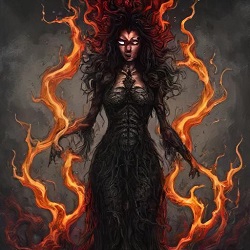
She is known as the female (life giving) manifestation of the helpful outcomes with her associated element; There is an associated male (destructive) manifestation. This Great Numinous Spirit which has manifested through the will of living Helca and is directed by Gaia in most things. While this ‘goddess’ has not affirmed participation in The Godspeak Accord of the realms, she generally follows the stance of Gaia. She has been known to manifest to fight against undead and those who would kill sacred beasts, places, and environmental manifestations under their protection without thought or bias to Light, Dark, Grey, or even Green foundations. She is considered by related elemental creatures to be the supreme arbitor of their behavior within the shere of Helca itself, and can summon and bind several of the associated elementals with ease. It is well known that the powers of Merkaine and Aerna work best to fight against the cold death of the Fangedfrost.
Fire Branded Lily Healing: The clergy of Merkaine seeks Lily Healing items because it warms a person, and this reflects the aspect of the faith directly. They are able to enhance the effects of the potions, philters, and elixirs. Those drinking them cannot be raised as undead within the next 3 days.
Aspects Known/Common Associations
Major Aspects: The fire that cleanses, life giving warmth, the drying of the drenched, transforming of habitat, the travelers friend, the closer of wounds, the kindler of passion.; These are common knowledge; Other aspects/symbols/emblems may vary by specific sect/cult or institution.
Minor Aspects:
Symbolized Role(s) and Value(s):
Emblem:
Sacred Observances: (These are reflected in the faith’s General Liturgy.)
- Sacred Events: [Sacrosanct festivals and milestone celebrations] >
- Sacred Places: [Sacrosanct locations and Pilgrimage sites] >
- Sacred Dates/Days: [Sacrosanct times of the year, recurring days of celebration or rest] >
- Sacred Times: [Sacrosanct period of a day, week, month, season, or year in a cycle] >
- Sacred Life: [Sacrosanct plants, animals, monsters, and entities] >
- Sacred Forms: [Sacrosanct colors, shapes, material (minerals, fabric, etc. )] >
- Sacred Works: [Sacrosanct documents, books, jobs/activities] >
- Sacred Items: [Sacrosanct utensils, tools, machines, clothes, armaments] >
- Sacred Armor/Defenses:
- Sacred Weapon/Offenses:
Pilgrimages and Sacred Places/Places:
Followers of the Faith
Favored Followers: Druids and those who venerate the Wyld Faith are the primary adherents.
For for information on Roleplaying a character of faith, see the Divine Follower guidelines.
Expectations & Obligations: Good Standing in relation to their faith’s tenets reflected in Liturgical Observations tenets. Nominally, the Tenets of the General Liturgy are followed by the Laity of Congregations and those of higher Grace and the few Institutional Ranks alike.
Belief Made Manifest – Beyond the General Litany
- Shared Litany Tenets:
- Abiding Litany Tenets:
- Combat Exclusion:
Manifestation and Favor
Connexion Range = Varies (enhanced through the Rite of Offering) > Conviction Limits = None; Elan Building is allowed (if used).Favored Avatar: A strikingly beautiful, swaying woman in deep red, orange and golden coverings of all fabrics. Her skin is golden, with palms, tongue and soles of black ash. Curly red hair that spills out in all directions, her feet leave burn marks and smoke trails in her footprints.
Minions and Servants
Armaments of the Faithful
Typical Elemental Divine Weapons; More powerful Magic/Mystic items are typically Singularly Bound if not Institutionally Bound.
- Average:
- Major:
- Extraordinary:
Rites of the Faith
Orders, Sects, Cults
Flickering Flame
The Flickering Flame,also known as the Order of Depelia (named after its first adherent Sister Depelia in CY 6710) is an order who follows Merkaine’s playful side, whimsical side – reflecting both chaos of flame, but a lighter side. They play to the kinder aspects of the Merkaine followers… their focus on story, fun, passion, and humor.
Motto/Saying: “‘Tis but a trick of the light!”
Hearth Fire Guardians
Inactive; Order Disbanded around CY 7200; The guardians were originally said to be women warriors, women of the north who had lost their families to the undead scourge of the Lich Lords. Over time, it grew and changed – widowers were allowed in, and eventually it became an unrecognized martial order. It had several shrines on the front lines of Kaald, and even sent a squad to the wall at Northgate Garrison. Gardia Delruk, the mother-matron of the order hunted down Kralloc the Red – a killer of priests in the north. His half demonic heart was ripped from his chest and cast into the flames, cursed. Rumor said it would not stop beating, and so she took it to a smithy and had it beaten until it no longer pumped. The blood was used to quench a suit of scale armor, imbuing it with magical properties – and so the rid-tinged scale armor became the symbol of the order for a thousand years. During this time, the “lady” who Kralloc served was hunted to extinction. This lady being a blue skinned hag, who kidnapped young women and bred them with her demon lover. The half demons were tracked over hundreds of years to their mothers lair, where the entire order converged. Half the order was wiped out, but the last of the priest killing soldiers, the hag, and her demon lover were all killed. The order was able to make several more scale suits, quenched in demons blood. Unfortunately the suits proved to be a curse. The ghost of Yallodocious the hag hunted down the wearers of the armor over the next 400 years, driving the order out of the north until the ghost was supposedly laid to rest in CY 7043 at great cost. All suits were destroyed after that, when their vulnerability to the hag’s mate was exposed. The guardians were then only a sacred band operating out of Northgate Garrison, in service to Merkaine. Without its northern support, the last of them left the wall in CY 7200. It is unknown what the fate of them was exactly, but one of their Lt’s was named Azrudur who was seen in north Umbak. He was supposedly killed by the Silver Talent knights and the last of the sacred hearth armor was taken. Rumors persist of the Umbakains attempt to wear it, placing it upon pages and squires and eventually discarding the last suit into a river in southern Dunstrand – somewhere in Bar-Innis during a foray whilst following “bandits”.
Motto/Saying: “The fire in the blood is my shield in the dark of night.”
Hearth Fire Armor
Scale Mail armor (and coif) that is tinged red. The scale have burnt red edges on them – making them look menacing.
Demon Armor; Scale Mail (not plate). The armor has a Resilience of 3 and absorbs 1 damage per dice of flame damage from any damage done to the wearer as long as a living person is wearing it. The wearer can spend 1 point to be able to see in any form of darkness (magical or not) for a round, as a Reaction. It also allows the wearer of the coif to sense demons when within 100m – including number and general power (HD).
Djerduth the Lord of Death
Posted on November 8, 2016 in Steel-Realms
>General Motto: “Death takes all.“
Quick Reference: Djerduth was once the “god of death”. A powerful demiurge which represents mortality, the cycle of life, frailty, passage of time, endings, and the cold dark emptiness of the void. ‘He’ was venerated only to ward off his presence, to appease his hunger, acknowledge endings, and little more. It is believed that this ‘god’ never had any presence at or in The Godspeak Accord or that it consciously chooses a side in regards to the Oath of the Day Watch. A few venerated him as the natural way of things, death not to be feared, but a passage to another time and place (this cult referred to him as the “Master of Passage”). As a symbol, his followers were everywhere – their mundane presence served as hospice and palliative care for the poor and weak. Actively, his symbol was the symbol for endings – endings of life as well as mundane acts; treaties, partnerships, relationships, etc. Ultimately all things fall to death, the priesthood would mark documents and other things with a symbol that meant “until death”. The specific signs/symbols of Djerduth vary by individual order and sect; Items in the Reliquary reflect general ideas associated with the Principal. The suppression of Djerduth has contributed to the rise of Restless Spirits of Helca.
Promise of the Afterlife
Only oblivion is offered to followers – eternal peace if they so desire. Otherwise, most followers seek out some level of devotion to another ideal and their Afterlife.
Clergy and Aspect Fallen: There is no formal clergy per se of Djerduth any more – though some traditions carry on. The small number of his followers that were not corrupted by the power of the Lich Lords found their powers barely functioned. The traditions of death as a part of the natural order, and that death personified did care about the solace of the living, ancestor worship and commune with the spirits of the dead – these things still exist in a few remote places, true and pure, though nearly bereft of power. Death as the natural order moved the Green Church and Wyld Faith, as the Lich Lords sought nothing more than a stop to death and then to sculpt the perfect world that exists only for their desires.
The most famous follower of the god was Alonzho Spirit-Walker – He was renowned for his compassion and mercy and known to be able to walk the the Halls of the Dead to return with final messages from loved ones for bereaved nobles. The money gained would go tot the succor of the poor and dying.
The modern age is heavily defined by the clash of faiths in the “Affray of Darkness and Light” in which he seeks to have no part in.
Aspects Known/Common Associations
Major Aspects: ; These are common knowledge; Other aspects/symbols/emblems may vary by specific sect/cult or institution.
Minor Aspects:
Symbolized Role(s) and Value(s):
Emblem:
Sacred Observances: (These are reflected in the faith’s General Liturgy.)
- Sacred Events: [Sacrosanct festivals and milestone celebrations] >
- Sacred Places: [Sacrosanct locations and Pilgrimage sites] >
- Sacred Dates/Days: [Sacrosanct times of the year, recurring days of celebration or rest] >
- Sacred Times: [Sacrosanct period of a day, week, month, season, or year in a cycle] >
- Sacred Life: [Sacrosanct plants, animals, monsters, and entities] >
- Sacred Forms: [Sacrosanct colors, shapes, material (minerals, fabric, etc. )] >
- Sacred Works: [Sacrosanct documents, books, jobs/activities] >
- Sacred Items: [Sacrosanct utensils, tools, machines, clothes, armaments] >
- Sacred Armor/Defenses:
- Sacred Weapon/Offenses: Sickle
Pilgrimages and Sacred Places/Places:
Followers of the Faith
Favored Followers:
For for information on Roleplaying a character of faith, see the Divine Follower guidelines.
Expectations & Obligations: Good Standing in relation to their faith’s tenets reflected in Liturgical Observations tenets. Nominally, the Tenets of the General Liturgy are followed by the Laity of Congregations and those of higher Grace and the few Institutional Ranks alike.
Belief Made Manifest – Beyond the General Litany
- Shared Litany Tenets:
- Abiding Litany Tenets:
- Combat Exclusion:
Manifestation and Favor
Connexion Range = Varies (enhanced through the Rite of Offering) > Conviction Limits = None; Elan Building is allowed (if used).Armaments of the Faithful: Typical Elemental Divine Weapons; More powerful Magic/Mystic items are typically Singularly Bound if not Institutionally Bound.
- Average:
- Major:
- Extraordinary:
- Cults, Sects, and Orders of Djerduth (Life’s Cold Passing)
- The Lich Lords of the Fallen North
- Powers (wielded and released) of the Lich Lords
- Records of The Winter Host
- The Winter Host (Minions and Armies)
- Eyes of Gleasone (priests)
- Masters of the Winter Host (Lich Lords)
- Necro Harbinger (Heralds of the Lich Lords)
- Druuzd Lords
- Ur-Druuzd (The Stone Walkers of the Winter Host)
- Gorvyrm, Master of the Blood Vurms
- Agent Bittermaw (once Thebadoux)
- Frostlock (warlock agent of the Lich Lords)
- Deathbride (mistress of the Fields of Blood; chief among the Flesh-Finders)
- Commander Heatherguard (Lich Lord general)
- Knight of Bones (Lich Lord’s minions)
- Records of Djerduth
- Reliquary of Djerduth
- Rites and Powers (wielded and invoked) of Djerduth
- Sacred Places of Djerduth
Rites of the Faith
Rite of Endless VoicesThe Rimbus (faerie earth-spirits; Uorfek)
Posted on February 27, 2016 in Steel-Realms
Legends say that The Rimbus were a band of earth spirits of Faerie cast, that were formed from the life magic of a dying Elven Soul Tree and the fell presence of The Deeping (of the Steel Realms). The truth is that they were on Helca long before then. Precursors to the personified and humanoid Elemental Consorts and Gaia & Darupet. Most were bound to the Navels of the greatests forests in The Noble East of the Steel Realms.
There were at least five distinct primary entities and they were venerated by The Edraim as holy messengers and carriers of the dead, and Ducateon as messengers of doom and death. In common with these is the stasis they brought, almost a malaise of calm. As the Edraim faded, so did the power of The Rimbus.
- Vaaurouch: Eyes of crystal, a voice of the deep tremor, and verdant steps; possibly the oldest and most powerful and tied to the Navel of Rhyl Forest.
- Uorfek
Now their presence is concentrated in a few “holy” places which are instinctively shunned by all other creatures. It is said there are still a few of The Edraim, watching and waiting for a sign, able to communicate with the Ducateon collective, the Orrish, giants, and that these holy places are also Faeywyld Crossings or where the Aelfpaths of the Steel Realms go through the earth. It is thought that Vaaurouch of The Rimbus is still alive and being venerated in the Navel of Rhyl Forest
The Spirits Manifested
Uorfek of the Loam
Left over from The Rimbus was a single spirit called Uorfek of the Loam. A spirit of mouldy earth and pox, natural disease and decay. It was seen as a spirit of change, of degeneration and transformation. At some point, it too vanished – around the time that the Sea-Kings were cast low and The Once-King was put down. It is associated with Mog Creoch in some records.
 iCore™ Entity Details
Pages on the web site lean towards i20™ text flavor, discrepancies will be noted in the iCore™ tab.
Chronicle/Facts of The Rimbus Spirits
Knowledge is broken down by ease of discovery/availability & Meticulous Record Keeping may improve usability; Any attempt to know more than what's Pervasive will require a reference, source, knowledge, check, or access to someone who can get or provide either of these. Specific Lores may increase the chance of knowing specific elements.
Trivial Outcome / Very Easy Difficulty & Pervasive Knowledge
Information Sources: Mundane Reference | Associated Phenomenology Only | Specific Lore
For those native to or long-dwelling in the region, ALL Common Knowledge may be Pervasive.
Rumors About the Locale
- The Ducateon were said to reject them and be inimical to their followers.
- The Dwarves are rumored to have known about them, but ignored them.
Simple Outcome / Easy Difficulty & Common Knowledge
For those native to or long-dwelling in the region, ALL Common Knowledge may be Pervasive.
Current Influence of The Rimbus
- The Rimbus are still venerated through symbols, though not by name.
- At the Schan-Karr of Enthavelaugh, Uorfek manifests as a patron.
- The followers of the tradition of The Suddahk and the ancient bond to The Rimbus and the numinous spirit of Ratuk are some of its most powerful and little known beyond the circle of World Watchers.
Minor Outcome / Average Difficulty & Uncommon Knowledge
They were venerated at the Elven Weald of Archaezeon when it was active.
Scarce Knowledge / Hard Difficulty
The Sunland Horns: There is a massive mound outline of an Elk in Sunland that is sacred to the Klaurians and a place of power for The Rimbus where they hold their frenzied moots – said to only be rivaled by the Grolllen.
They could travel locally on Helca using the Aelfpaths of the Steel Realms, like faerie-kin.
The spirits are said to have some connection or alliance with the ancient Druunad of Helca.
Rare Knowledge / Very Hard Difficulty
The sign of The Rimbus is upon the ruins of Tell Cunetha where the Har Cunetha gather and give thanks to the spirits of the woodlands and earth sometimes.
The Winter Elves are said to have facilitated their coming and still consort with those still alive on Helca.
The spirits of The Rimbus were invited by Living Helca!