Tag: loc-dunst
Wonald Delta
Posted on November 15, 2021 in Steel-Realms
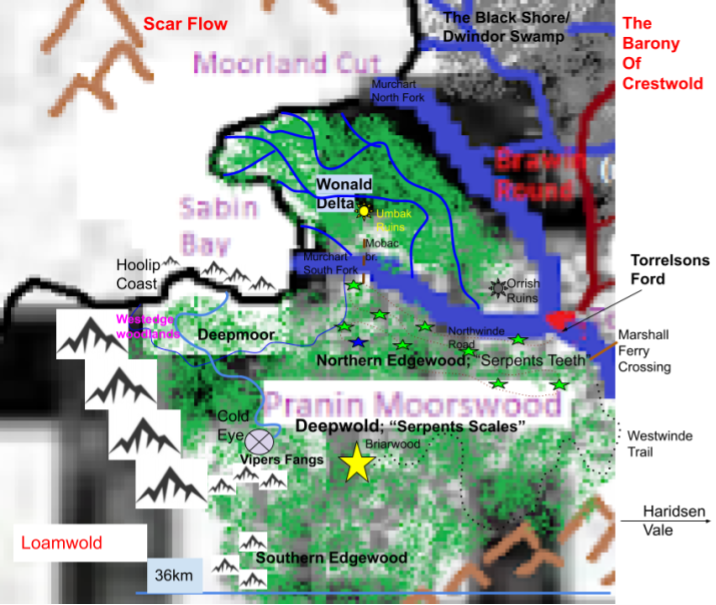
Sabin Bay, along with the Pranin Moorswood and Wonald Delata, are claimed as territories under the watch and sanction of the Druids of Pranin – the druidhold of Moordaeth. The Wonald Delta and the south fork of the Murchart River are part of it, but not according to the baron of Crestwold.

History and Tales of the fief of Cabella
Posted on October 13, 2021 in Steel-Realms
The area of what is now known as Cabella was often fought over between the Dreadlords of Bronze and the Sea-King empire. The Verbuir clan destroy the Dreadlords utterly, devastating the region and causing the weakened Verbuir to be wiped out by rival political factions. The first of the free cities – Karolak – that would become the merchant cities of the north are founded along the north side of the renamed Beyne River. The magics used in the great battles of old ruined the land for thousands of years. The Amberswell area was re-settled in 6054, long after The Sundering in 5000 had freed it from any Sea-King control and opened Grent’s Inlet – about 50 years after the first traders discovered the area held Amber. It was discovered to be the source of Amber for almost the entire north. The coast, where the tribes folk who lived in the foothills of the Skaret Hills gathered it, was dangerous. The sharp rocks and tide pools filled with poisonous urchins and angry giant gulls held too many perils for the local traders – they continued to let the tribes folk collect the Amber from the sea. The city’s name comes from the amber source and the ‘swells’ – waves – which would cast the amber on the rocky shore. Once pronounced amber-swell, it is now know as Ambers-well. Over the course of the next several decades, some mines were dug to search for Amber. ‘Mine’ is not the right word, for really they were just tunnels into the soft earth, searching for the stone which seems to appear at times in Ghora Basin. The basin was for Capt. James Ghora, who would brave the perilous seas to sometimes bring trade to the Morsayne coast – through typical Umbakian privateers. The basin faced the sea – sloping about 100m below the mainland level and leveling at 5m above the sea. A few finds were made and mined, but the soft earth caused many mines to collapse and many to lose their lives. An attempt was made to take the tribes folk’s dangerous jobs, but few could survive the conditions on the coast – the basin would often turn into a dangerous marsh after heavy storms. During this time, the population of giant gulls was exterminated. A mining town named Walfirk was established for a short time when silver was found near mt. Corporphis. This caused Umbak to try and forcefully settle the region (causing the Merchant Cities to also take notice of the region) – but the vein and town busted in 7001 when the silver ran out.
Chronicle of Cabella
Information Sources: Mundane Reference | Associated Phenomenology Only | Specific Lore
Knowledge is broken down by ease of discovery/availability & Meticulous Record Keeping may improve usability; Any attempt to know more than what's Pervasive will require a reference, source, knowledge, check, or access to someone who can get or provide either of these. Specific Lores may increase the chance of knowing specific elements.
Trivial Outcome / Very Easy Difficulty & Pervasive Knowledge
Clashes and Truce with the Elves
It was about CY 7000 that the area had its first clashes with the Chauvelah elves (due to aggressive Umbakian influence) – and after a truce was worked that allowed logging and a balance between human consumption and elvish necessity. The region’s first encompassing truce between settlers of Amberswell, elves and tribes was made at Dragon Rock.
Simple Outcome / Easy Difficulty & Common Knowledge
The becalming effects from The Odyssey of Elancil’s Wound persisted in Cabella until about CY 8600 – it became dead coast for a hundred of years – utterly becalmed.
In 8640, two wizards took to feuding, one of House Malor and one from Lord Saerical north in Merchant City lands. It drove Karolak into a war with Dunstrand. The city was attacked and its walls pulled down. The Duke responded with an overwhelming force, and drove out the Merchant Prinz folk after a bitter full year campaign, charging the baron Veff of West River Run to nominally defend the area as the militia army had been wiped out. This is when the Hollingsworth family was given their land and titles after the previous lord’s family was wiped out.
Recent Events
In CY 9126, during the War of Sister’s Ascention, Baron Steven Rotchester, one time henchmen of Sir Alois Durgrimm (knight of Ikribu/Protector of Ados, Slayer of Orks; married to Bejerrie of Ados) declared Amberswell for the side of Bejerrie Durgrimm. With him stood the Rector and patriarch of Balthazaar’s church in Amberswell.
Reisers Cross was the scene of a battle between Cabellan native forces and those of West River Run who supported D’avlin claims to the throne. The native’s lost and thus began the recent decline of the region – and abandonment by the Lightbringer (along with an influx of Wyld faith and Elancil worship) clergy. A new “Baron of Amberswell” was placed by West River Run, and troops garrisoned throughout the region. The strange thing about the campaign was that towards the end, before the battle, Sir Steven was said to give a speech and warned that if Cabella did not win this territory for House Durgrimm, thrice would it be cursed. After the battle, during the violent occupation by West River Run forces that followed, three events took place which many consider to be the thrice cursed results. The first was a plague of rats which started on the south coast. They brought disease and tourism was reduced to a minimum. The second was 2 years of fire and blade raids by Orrish – and sudden cessation. Two entire villages were butchered and burnt to the ground, many others attacked repeatedly. Lastly, about 5 years ago, three of the amber mines collapsed, killing dozens. After this, the region never recovered. The “Grimmers” is what the supporters of the curse theory were called. They spread dissent constantly. All were hunted down after the battle of Mingers Marsh, especially after rumors persisted that the remainder were trying to plunder the Blighted places to finance the ‘rebellion’.
Minor Outcome / Average Difficulty & Uncommon Knowledge
After the becalming effects of The Odyssey of Elancil’s Wound wore off in Cabella around CY 8600, it appeared again in Gwinn’s attempts to conquer the Tarmysian Peninsula by becalming their ships. It has also diminished their priests’ powers as they sought to land troops.
Vorben Highmoor Event – Silver Found: In 8823 A war band led by Jermiah Temilsan of West River Run, a knight making his name trying to drive the Orrish out of the Vorben Highmoor and claim some small dominion. He and his men were caught in an ambush. The Orrish pinned them in a ravine and were raining slings down mercilessly. He perished in the night, a blow to the head. However, one of the sling stones dropped a soldier trying to climb out, which caused a small landslide and exposed silver. The Orrish left by sunrise, leaving most dead.
Vorben Highmoor Event – The Blight Gas: Not long after a mining town grew up on the site – named after the fallen knight. Not soon after gold was discovered, along with iron. Long thought to be devoid of resources, the area became a veritable boom area overnight. The magus of Speljan erected a tower in 8888 and the area had really begun to settle – despite the miserable weather, Orrish, and tough terrain. Then, it all came crashing down. Most of the specific details are lost due to the circumstances. Most claim it was the company of Darsiver and Sons with a claim on a new found deep vein of gold. Some pockets of trapped gas were expelled into the mines. The Blight Gas, as it came to be known, soon strangled in a manner most horrible and caused those killed to rise again and stalk the living. The mines of Korgoth were abandoned. However that was not the end. In two days, the town of Temilsan was overcome. The countryside was a hell on earth, the living – Orrish and Lightdwellers alike were hunted. The magus of Speljan was able to contain the infection at Temilsan, but somehow brought the gas’s effects back to his manor, village and tower. It is said the mage of Speljan perished in his tower, though some say he watches over the still ruins of his manse and the town from the tower of his home.
Scarce Knowledge / Hard Difficulty
The The Odyssey of Elancil’s Wound significantly expanded the Chauvelah Weald. Logging rights have been contested ever since.
Gatesmount (Riverdan)
Posted on July 6, 2021 in Steel-Realms
Geo-Location: Duchy of Dunstrand
The capital of ___ has a population of 1,700 (though in the far past it was 3-5 times that).
Defining Ideal: The Riverdans has always seen themselves as a bastion of independence & freedom within The Grand Duchy of Dunstrand. They safeguard the traditions of the Fallen East, personal freedom, the nobility of service, and bloodline purity. "Where the river Nanford once flowed, so flows the blood and honor of tradition and loyalty."
Defining Moment: All of the Riverdans were devastated when, in CY 7950-7986, Nanford River changed course during the Storm Times and Dwindor Swamp became a living things itself and gained the appellation of “Mighty Dwindor”.
Unless a specific alternative is provided, Commoners of the Noble East coming of age in/from this Experience will shape their perspective to the Cultural Experience of the Riverdans. A group of characters can form a shared Cultural Bond.
Known For:
Ruled By: (Pledged Directly to the Duke of Dunstrand)
Rulership: Active; [‘Lord-Steward’ is proper, ‘Baron’ outside of Dunstrand] (Titled, peerage [knightly grant] based, matriarchal lineage)
Seat of Rule: The city of
> Symbol:
Factions: The most ancient faction is based on the lineage of the old families from the Fallen East. Like all the old families, they are associated with the League of the White Lily & brought their Dryad refuge through the ancient association with the Osten-Paullus faith.
Armed Forces
Size/Composition:
[Approximate] Professional = / Volunteer = / Mercenary = / Levy =
Pacification Garrison Presence: NO
Total Population:
[Approximate] Urban = / Rural = / Remote =
Transient: Very little due to the economic depression suffered by the river lands.
Racial Division and Relations: Like all the Riverdans, the population is almost 90% human. A few Grollen, Half Elves, and Dwarves have found their way into the old lands due to the general acceptance (though they are still treated as outsiders) of any people.
Social/Cultural Norms of Note: The folk of this place share the common culture of the Riverdans. They take pride in the origins and shared culture with ancient traditions. They all share some common historical events, such as the River Nanford changing course. They are obsessive about their bloodlines and preserving the records around them.
Divine Associations/Religion: The Riverdan folk are not overly religious, though they still observe many of the ancient Rites and traditions of the vanishing Osten-Paullus faith of the Fallen East. Over time, all of the families have gravitated more towards the Green Church and mother Gaia – even welcoming in Druids of the Wyld Faith since the impoverished and somewhat abandoned Riverdans are slowly “returning to nature”.
Common Names:
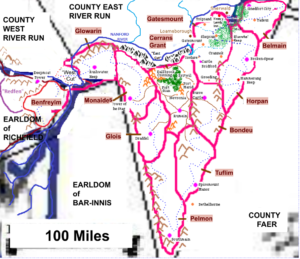
Riverdan Basic Map
Commerce, Economy, and Travel
Annual $:
Roads and Transport: Most roads are in disrepair. Markers have been left to rot or become overgrown. The river-side territories on the south are mostly lush flood plain lands. The river rarely floods any more, and all settlements are built on rises above the river levels. A few dykes or small seasonal dams are ready but often fail due to their state of disrepair.
Primary Imports:
>
Primary Exports: Orchards, grains, and grasses are plentiful.
When the river floods, it deposits silt and nutrients. The silver crown is accepted everywhere, but many transactions between those who live here are on a barter system due to the monetary poverty of the fiefs.
Crime/Criminal Element(s): There is not enough trade and capital to support any kind of large scale organized crime. Most criminals are opportunistic, though in a few large cities a small gang may be organized to run some local operation. Because of the currently impoverished nature of the Riverdans, many criminals are not treated harshly for non violent crimes (and there is a lack of jail facilities), while violent crime is often responded to with a level of severity greater than the crime.The people are fiercely community-minded and disturbing that peace is sometimes even dealt with in vigilante style.
More Materials
Adventures in the Area
Adventure Ideas
General adventuring in the Riverdans has some common threads…
Institutions & Lineages of the Riverdans
Posted on July 6, 2021 in Steel-Realms
The Families/Bloodlines Lineages of the Riverdans have their own ancient laws and each ruler has, by Ducal decree from the founding days, full autonomous authority in their own fief; Each small territory has its own hereditary ruler – a fiefdom where the ruler has absolute, near king-like control (unlike the official ‘counties’ and smaller peer titles of the Duchy). Where the hereditary families still rule, these lords are addressed as Barons (considered a sleight by them), otherwise ‘Lord-Steward’ with a knighted family name.
Defining Ideal: The Riverdans has always seen themselves as a bastion of independence & freedom within The Grand Duchy of Dunstrand. They safeguard the traditions of the Fallen East, personal freedom, the nobility of service, and bloodline purity. "Where the river Nanford once flowed, so flows the blood and honor of tradition and loyalty."
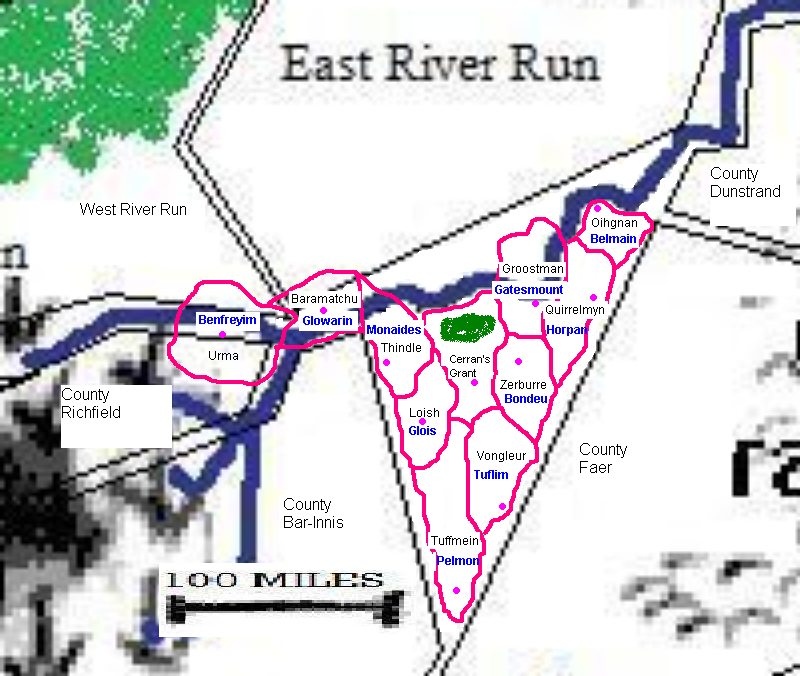
Riverdan Family Affiliation Map
Original Family Names
- Belmain (Oihgnan; “oy-nan” family)
- Benfreyim (Urma; “oor-ma” family)
- Tuflim (Vongleur; “vhon-glu-er” family)
- Horpan (Quirrelmyn; “kwer-el-min” family)
- Gatesmount (Groostman; “Groostman” family)
- Bondeu (Burren family)
- Monaides (Thindle; “tin-del” family)
- Glowarin (Baramatchu; “baram-achoo” family)
- Glois (Loish family)
- Pelmon (Tuffmein; “tuff-main” family)
Dans of the Riverlands
Posted on June 1, 2021 in Steel-Realms
The Riverdans (“River Lands”) of The grand Duchy of Dunstrand is mostly a homogeneous mono-culture. It is based on the values and structures of the ancient Fallen East that have evolved over time.
Defining Ideal: The Riverdans has always seen themselves as a bastion of independence & freedom within The Grand Duchy of Dunstrand. They safeguard the traditions of the Fallen East, personal freedom, the nobility of service, and bloodline purity. "Where the river Nanford once flowed, so flows the blood and honor of tradition and loyalty."
Defining Moment: All of the Riverdans were devastated when, in CY 7950-7986, Nanford River changed course during the Storm Times and Dwindor Swamp became a living things itself and gained the appellation of “Mighty Dwindor”.
Unless a specific alternative is provided, Commoners of the Noble East coming of age in/from this Experience will shape their perspective to the Cultural Experience of the Riverdans. A group of characters can form a shared Cultural Bond.
Riverdan Culture
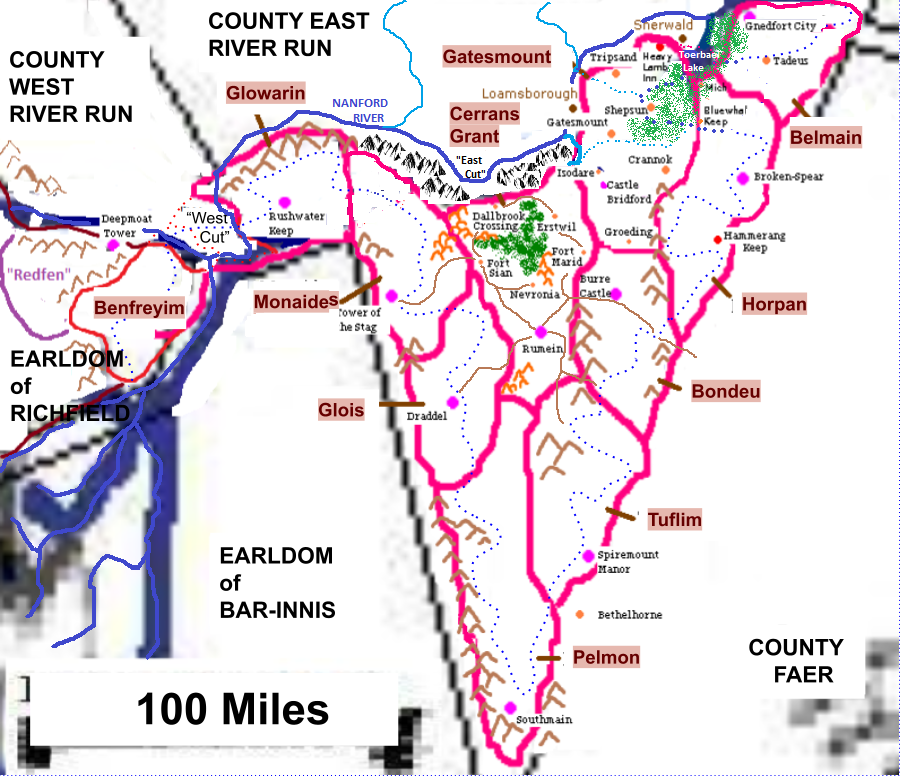
The Riverdans are some of the oldest settled territory of Dunstrand. It consists of small tracts, initially parceled to the family leaders and knights of the Lords of noble families from The Fallen East, who helped to settle Dunstrand Vale. These holdings have been passed down hereditarily for years, they taking great pride in preserving their bloodlines (on the female side – as the tradition of the east). Some blood lines may have died out, and have been assimilated into the larger counties but many yet continue. Many of the traditions of the east are preserved in their culture – the animism, veneration of animal spirits, generosity to strangers, the kingly tradition of service to the people (‘The Lord Should Live no Better Than the People Who Serve Under Them’).
The Nanford River changed course starting in CY 7950, devastating the Riverlands and taking from the ancient families their prominent position in Dunstrand political and economic scenes. These ‘dans (Riverdan, Danlands) are tracts are usually no more than a few dozen miles in each direction – once magnificent with road markers, rest stops, and endless fields of wheat… now though, roads are in disrepair and traveling is rough. Lavish old keeps and manors with villages or small towns are the center of each, few have more than that single large center… although some have smaller villages on remote edges.
The people of the Riverdans are bitter, singularly set in their ways and fiercely independent. Their place in politics has gradually been usurped by the larger counties – who they consider their enemies since no one came to help when the counties north of the Nanford made their play to rule all trade in Dunstrand. Since the river course changed, the lands and keeps have become destitute and dilapidated over time, but the people still cling to their traditions and ways proudly. The land is fertile enough, but control of all the trade is through routes and merchant houses owing their allegiance to the Twin River powers in the north. What happens in one territory tends to stay there, and they long ago took oaths so that no one could have power over the others and have clung to this federation loyalty over the ages. Now however, they squabble and argue over borders and rights and cannot seem to band together in any way except to defend against military incursion. Faith is one of the few bonds of the Riverdans. The Wyld Faith and Green Church is strong, especially Rastur; Remnants of the ancient faith of Osten-Paullus (vanished sect of the Fallen East). The Earldom of Bar-Innis has decent relations with the Riverdans as it shares some of the historical period and meaning.